Articles
LGM vs LLM
January 12, 2026
What is an LGM?
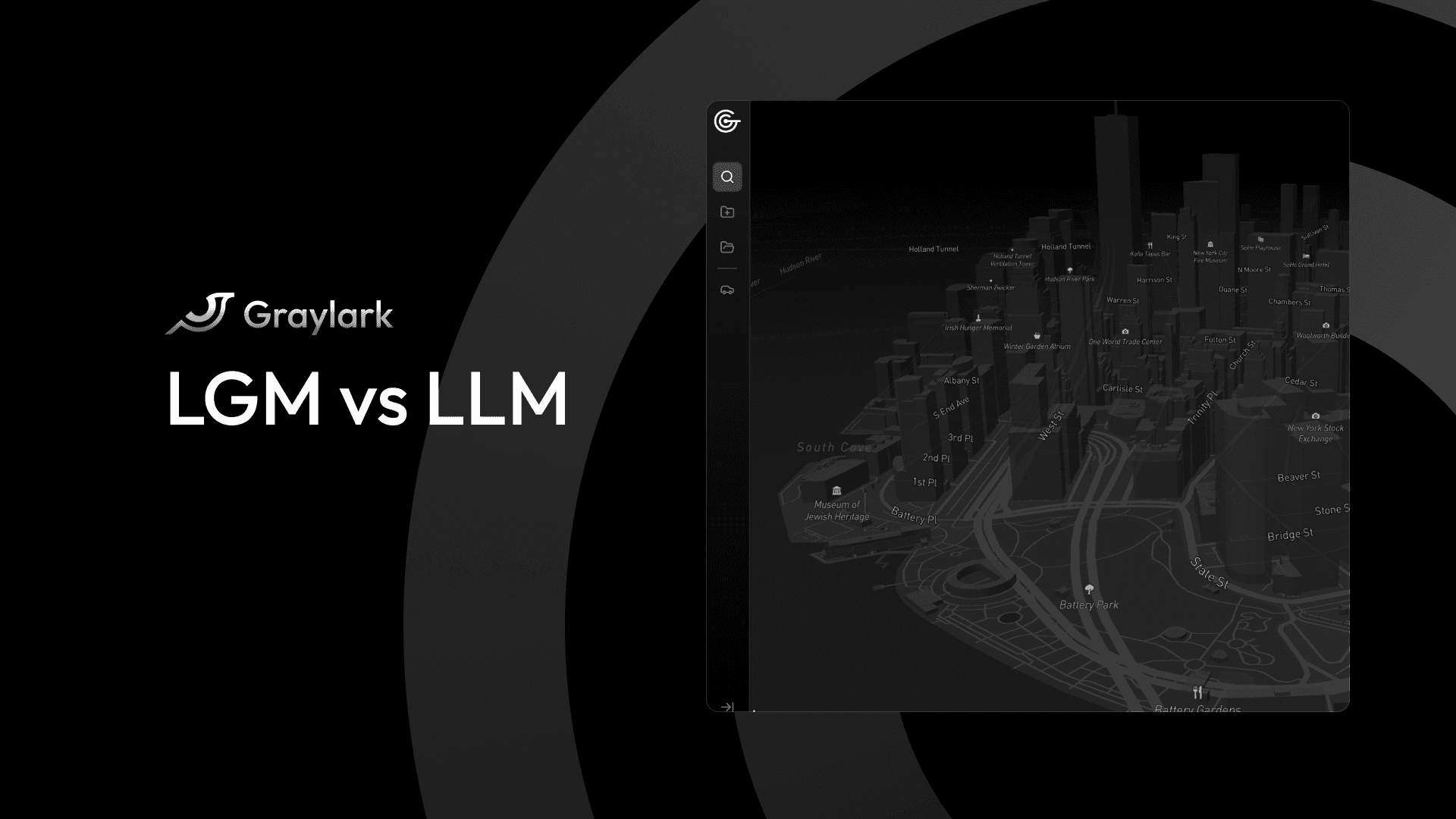
A Large Geospatial Model (LGM) stands apart as an uncommon AI capable of more than simple object recognition, it is designed to be truly spatially aware, connecting visual data directly to its real-world location and context.
For example, imagine a rhino named Cal. An LLM can tell you, “That is Cal the rhino,” but an LGM tells you where Cal is. It considers details like the trees behind him, sun angles, and the red dust on his horns, and knows such an environment exists only at the Lewa Conservancy in Kenya.
In short, an LGM synthesises real images, scans/photos, 3d data (or high-dimensional visual rasters, photogrammetric scans, and volumetric 3D data) into a spatial brain. By being trained on 3D info and physical data, it goes beyond an LLM's ability to just tell you something and instead shows you something deeper. It answers the fundamental question of "Where am I?" by identifying exactly what you’re looking at, how you are oriented, and your true perspective within the physical world.
How is an LGM different from an LLM?
An LLM or large language model is primarily focused on finding the correlation between tokens, or in other words, words, and making inferences based on the prompts you feed it. There are thousands of these models, and while they are brilliant at conversation, LGMs are geared towards the physical world.
In contrast, a true LGM like GeoSpy is a rare breed. These models don't just predict the next word; they interpret nonlinear, multidimensional data from the real world. Specifically, they digest real-world images, photogrammetric scans, and volumetric data at a scale that is hard to imagine.
Ultimately, the difference comes down to Knowledge vs. Navigation.
An LLM is a master of what has been written; it can describe the world to you from a library of human thought. But an LGM is a master of what exists; it perceives the world through a geometric lens, informed by physical data.
We have spent the last few years teaching AI how to speak. With the rise of LGMs like GeoSpy, we are finally teaching AI how to see and sense where it is. We are moving away from models that just answer our questions, toward "Spatial Brains" that can guide us through our physical reality.
The future of AI isn't just on our screens, it's in the space around us.
Why are LGMs important, and what industries do they help?
Let’s use the GeoSpy model as an example.
Law Enforcement
In the past, geolocating a crime scene, stolen items, or a missing person was a manual, time-consuming, and painstaking operation. Law enforcement had to use exhaustive investigative resources, spending hundreds of hours cross-referencing landmarks and local infrastructure. This resulted in major operational lag, with investigations taking months of committed work when timing was critical.
GeoSpy turns that months-long timeline into a 30-second solution.
Insurance
People constantly defraud the system, whether by staging an accident, lying about the location to avoid blame, or inflating the claim. GeoSpy serves as a truthlayer, matching the road texture, foliage, and solar angles to the reported location of the claim.
GeoSpy turns a weeks-long fraud investigation into an instant verification, preventing you from being forced to pay higher premiums due to undetected fraud.
Food Delivery
We’ve all had dinner delivered to the incorrect home. While GPS gets a driver to the block, GeoSpy analyses the "proof of delivery" photo to ensure the porch DNA matches your home, solving the "last meter" problem that satellites overlook. It ensures that your dinner ends up on your table, not your neighbour’s.
Journalism
GeoSpy automates global media verification.
An LGM does not depend on assumptions or narratives; it grounds every conclusion in geometry, space, and physical reality. By analysing the "visual DNA" of a video and matching it to soil, architectural styles, and solar angles at the reported location, GeoSpy can verify a clip's authenticity in 30 seconds. This protects the quality of information delivered to citizens, ensuring that the media remains a reliable bridge between the reality of a conflict and the global public’s understanding of it.
Why are there few LGMs in the world?
Building an LLM is like reading every book; building an LGM is like reconstructing the library.
The data is heavy. Unlike a book, which has a clear, linear structure, geospatial data is chaotic. It is multimodal and fragmented, existing in multi-resolution forms. In order to train an LGM on what “the world looks like,, you must scrape millions of images from the internet, public records, and satellite databases where the metadata is still intact. Ensuring data quality at scale is both expensive and requires substantial storage infrastructure. The processing capability required for images, such as 3D LiDAR scans, is significantly higher than that for text. It requires massive GPU clusters to process trillions of pixels needed to “learn” the Earth. Creating a system at this level requires an extraordinary convergence of data, infrastructure, and scientific talent.
For LLMs, being “close” is usually sufficient, but precision is crucial for an LGM. Let's take an example of a hostage situation. If the LGM a law enforcement relies on only has a 95% accuracy, it could point them in the direction of the wrong building or even worse, the wrong town or city. In these situations, accuracy isn't a feature; it's the difference between life and death.
Ensuring the model can differentiate between two identical-looking suburban streets requires a level of "Metric Scaling" that most AI companies simply can't achieve. The true challenge is acquiring data that encompasses 100% of a region while allowing cross-referencing of micro variables at varying levels of resolution. It analyses the soil mineral profile, the sun’s angle at a specific latitude, variations in topography and typography, vegetation species, and other cross-regional nuances that differentiate a specific location. This requires a much more complex neural architecture than teaching it to predict the next word in a sentence.
Trust, Safety, and Ethical Use
Spatial intelligence must be used responsibly. At Graylark, we prevent misuse and uphold privacy.
GeoSpy uses controlled access, auditability, and human oversight. Every action is reviewable; anonymous access and passive mass monitoring are not allowed.
We work with partners who protect, verify, and respond. Our aim is to empower safety and clarity, not erode privacy.
Concluding points
Overall, an LLM is a master of what has been written, but an LGM is a master of what actually exists. By solving the 'Where' through geometry and physical data, Graylark is shifting the AI frontier from mere conversation to true environmental awareness.
GeoSpy is a purpose-built LGM, designed to understand the physical world. Graylark is creating AI to answer: Where am I?